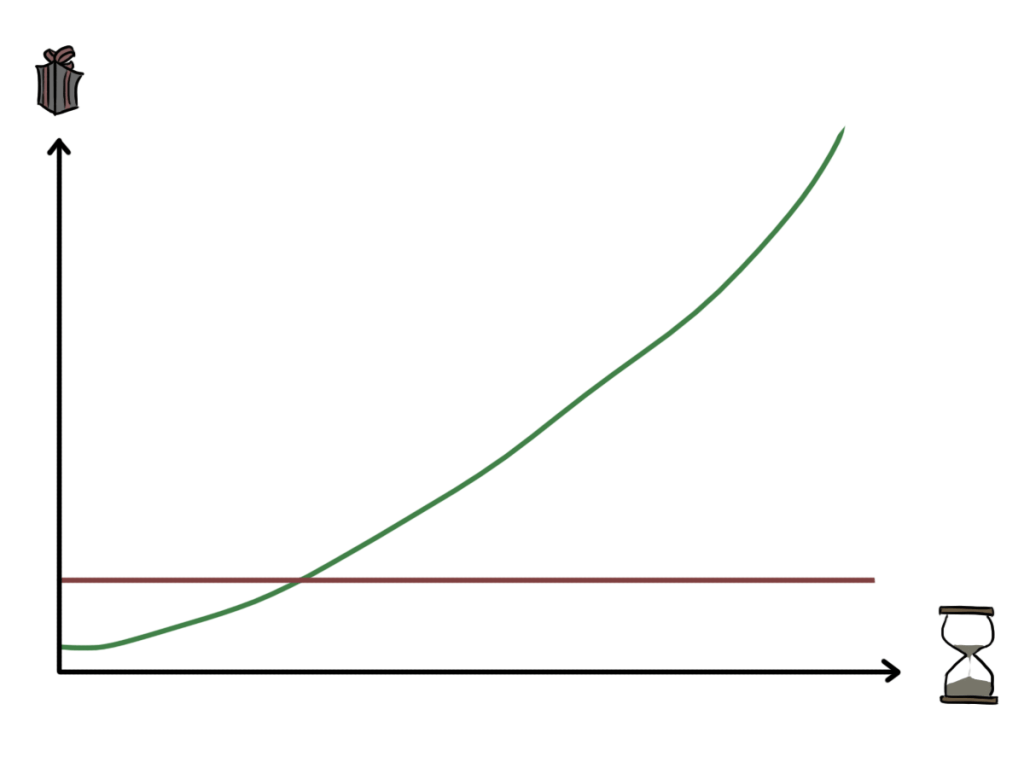
Pity timer is a game mechanic that rigs the probability of the outcome depending on the previous outcomes, to make it more likely to align with the expected outcome. In other words, it’s meant to reduce the odds of extreme edge scenarios, such as receiving a negative outcome multiple times in a row or never receiving a positive outcome despite playing for many hours.
The term was popularized after the release of the game “Hearthstone”. In this game, each card pack had, on average, a 5% chance that it would contain a legendary card. The player briel_hs gathered a huge amount of data to test it out, and he posted the results online alongside a hypothesis that a pity timer exists here. Developers eventually changed the detailed card pack description to include information about the guaranteed legendary when opening at least 40 card packs.
The reasoning
A lot of people struggle to understand how probability works, and such people are often susceptible to the so-called gambler’s fallacy. Citing Wikipedia, it’s “the belief that, if an event (whose occurrences are independent and identically distributed) has occurred less frequently than expected, it is more likely to happen again in the future (or vice versa).” So, pretty much what a pity timer is trying to imitate.
The games are expected to fulfill players’ expectations, even if it means rigging them. Technically, we could educate people to improve their understanding of probability, but it would be much more time-consuming than changing the reality to match their expectations. In the end, players play games mainly to enjoy them, not to be “educated.”
Even though a pity timer is not mathematically fair, it is perceived as a fair mechanism from the perspective of players. In the end, it reduces the odds that one player will be luckier than another.
Use cases
This feature is used mostly in games that:
- have randomized micro-transactions
- are looter games
- are meant to be competitive
Randomized micro-transactions
Pity timers have become popular among games that contain any variant of loot boxes (such as mentioned earlier, card packs). People who pay money for randomized content often feel cheated if their rewards are far worse than expected. Some of them would suspect that games purposely reduced the odds of getting a valuable item to encourage them to spend their money again. Even if such claims are incorrect, people spreading them can damage the game’s reputation.
Unifying progression systems
In games with random loot, the players’ luck affects the game difficulty. A player who is lucky enough to find multiple great items will have a much stronger character than a player who has no luck at all. If the game’s goal becomes too easy, it becomes boring. If the game’s goal becomes too hard, it becomes frustrating. Reducing the gap in players’ progressions is an important step in creating an enjoyable experience for everyone.
An example of a looter game with a pity timer is the game “Diablo 3,” which increases the odds of stumbling into a legendary item the longer you play without finding one.
Fairer competitiveness
People who play competitive games demand fairness. Randomness is an interesting factor in such games because it tests players’ adaptability to unexpected situations, and it makes the match more exciting. However, too much luck for one player may give him too much of an advantage over his opponent, making the match feel unfair.
Some games rig the randomness to reduce the odds that vary a lot from the expected average. An example would be the game “Dota 2,” where a lot of randomness is rigged that way, which includes things like critical hit chance or skill proc chance.
Controversies
Even though people want games to fit their expectations, they often don’t like the idea of rigging. Even if the intentions behind it are good, they may still consider it an immoral practice.
Pushing the line
Developers usually won’t do things that are far from acceptable. If pity timers become a widely accepted practice, game developers may want to try to push the line further. Once developers are caught rigging something behind the scenes, people lose their trust in them. If they rigged one thing, they might as well rig something else, and people can’t be sure of that until developers are caught again.
Complexity and transparency
Rigging is not that bad if it’s transparent. People want to know what they’re getting into. However, the rigging mechanics are usually complex, and explaining them can be time-consuming and inconvenient. As an example, I will use a graph that represents how the probabilities of landing a 25% critical hit change in “Dota 2” depending on the previous outcomes:
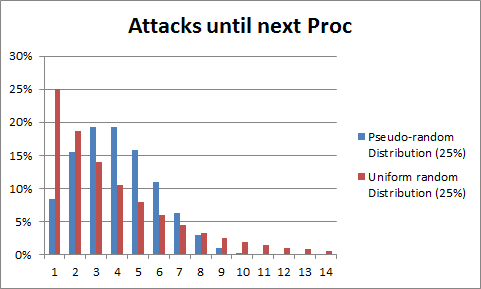
If we wanted a game to be fully transparent, we would need to include a similar graph in every description that includes a 25% proc chance. Alternatively, we would need to include such a graph in the tutorial (inconveniently increasing its duration) or include this info in the game’s rulebook.
Being vague improves the overall user experience, but makes the game less transparent and trustworthy.
Potential system abuse
Players who understand the system well might try to abuse it. Imagine a game where, at any time, you can choose to combat a neutral character or another player. If the system ensures that missing a critical hit 9 times in a row will guarantee success on the next one, the player might decide to attack neutral characters until he meets that criteria, and then switch to combat the player, having a guaranteed advantage right from the start. Luckily, it would be too troublesome to pull off, but the odds of such abuse exist.
The more transparent the system is, the higher the chance someone will try to abuse it, especially if it includes third-party programs like bots. At this point, pleasing players becomes a cursed problem, because you will have to choose between being transparently truthful or fighting players who try to abuse the system.
Pity timer’s cost
Some people probably don’t realize that, but if the average result stays the same despite pity timer, then the system prevents us from terrible luck at the cost of reducing the odds of good luck. In the long run, it’s not an issue, but it may slightly worsen the initial player’s experience.
Deepening fallacies
People tend to subconsciously register behaviors that happen in real life, shaping their future expectations. Since pity timers emulate expectations of people with the gambler’s fallacy, the increased popularity of pity timers reduces the frequency of real randomness. People used to rigging may subconsciously consider it an intuitive norm, meaning that true randomness will become less intuitive and more unnatural to them. In other words, it will make the gambler’s fallacy more common.
 Game Anatomy
Leave a comment