Fast-paced games are often praised for how thrilling they are. The suspense created by prolonged gameplay can generate a different kind of excitement, which is why games often offer tools that enable it. Unfortunately, our positive emotions can wear off if the game’s state becomes stale.
There are many tools that can contribute to the match prolongation. Healing effects are a simple example – they cancel out a character’s injuries, meaning a part of the game state is being reversed to an earlier stage. The match can also be prolonged by effects like:
– disabling enemies (e.g., stunning, silencing, or immobilizing them)
– sabotaging their resources (e.g., draining their mana, or discarding their cards)
– disengaging combat (e.g., by running away, or by removing enemies from the combat zone)
Keep in mind that such tools aren’t inherently evil – they often create a space for tactical choices that increase strategic depth, or add new skill layers to the game, such as increased weight of cooperation (e.g., in MMORPGs, some players specialize their characters in stalling as a tank or healer, to fill important roles during “raids”).
Since the playstyle of an opponent in games is often predetermined (e.g., by the faction they play or the build they use), prolonging matches will result in spending more time playing against that opponent’s playstyle. If no changes in playstyles are made for a longer period of time, the game may become monotonous.
Intentional stalling
Longer games aren’t a bad thing if they happen occasionally, but may become frustrating when they become a viable strategy commonly used by opponents (meaning it can spontaneously become a huge issue in PvP games).
Sometimes, stalling can yield significant benefits to the player who forces it. For example, in auto-battler games, there is often an option to raid another player’s defense team. The attacking player can gain an advantage by adjusting their team’s composition and positioning to counter the opponent’s team perfectly. If the attacker fails to defeat the opponent’s team in a set amount of time, the defender automatically wins. People figured out that building a highly durable team is the best choice for defense, because it gives them a chance to stall until the timer goes out, even if the attacker’s team technically counters them.
“Dragonheir: Silent Gods” is an example of auto-battler game, where the stalling mechanic can be used in the player’s favor. It’s so effective that it can work even for the top players, as shown in this example video.
Paradoxically, even though game timers are meant to prevent stalling toxicity by setting a maximum encounter duration, they can lead to so-called perverse incentives, meaning the result may be contrary to the designer’s intentions. Even if stalling doesn’t guarantee you a win, it may expose opponents’ weaknesses that aren’t necessarily meant to be taken advantage of.
In the game “Pokémon Go,” a 1v1 match ends when one player loses their team or the match timer expires. After the timeout, the player with more remaining Pokémon wins (or, in case of a draw, the one with the highest percentage of teams’ health, etc.). Some players play bulky Pokémon and use abilities that weaken the attack of enemies, intentionally prolonging the match to change the win condition to their favor and beat an opponent who isn’t prepared for it.
Sometimes, exploits get out of hand, and players find unique ways to abuse game rules by creatively manipulating the game’s timers.
In the game “Hearthstone,” players have a limited time to make their turn, but it’s also consumed during animations. Since player has to wait for all animations to finish before doing their turn, some players have figured out that they can play multiple cards with long animations and end their turn to forcibly skip their opponent’s turn (it’s worth noting that animations may be longer for the opponent). Although such exploits could be prevented by developers with proper coding, they can occur unexpectedly and cause significant frustration among players.
Even though time restrictions in PvP games sound like a decent solution to prevent players from extensive stalling, players still abuse the timers by AFKing till the last second of their turn (or even going completely AFK, either by minimizing the game or turning it off without reconnecting). Players who’re interested in having fun more than winning are often willing to concede against an opponent who tries to waste their time. Some players stall, hoping that an impatient opponent will give them a free win. However, there are also players who don’t even do this for their benefit – they just want to annoy the opponent.
Roping/stalling is a commonly known toxic behavior in the game “Magic: The Gathering Arena.” Players usually do this to “punish” the players who don’t play the way the roping player thinks the game should be played. For example, some players would do this against people who play aggro decks, while others would do this against people who play control decks.
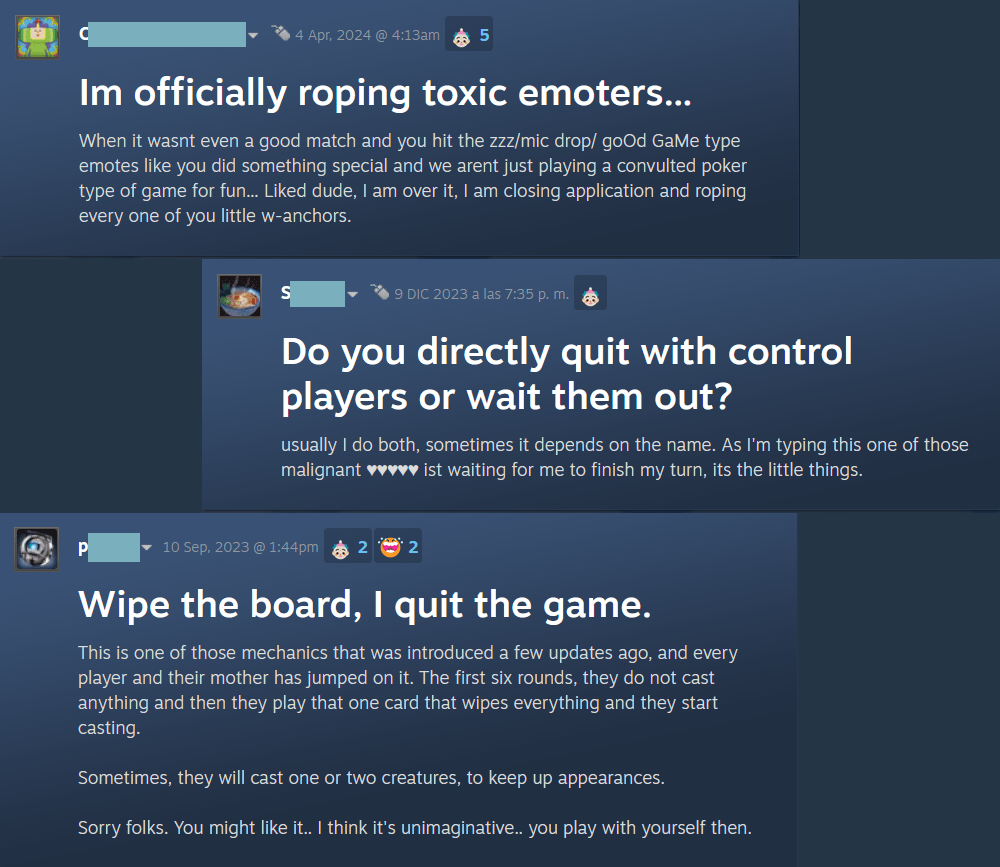
The problem among the “Magic: The Gathering Arena” community is so vast that the term “roping” was used on their Steam forum alone over a thousand times, and some people proudly admit to having done it themselves, believing their bullying has a good cause.
Slower account progression
It’s an issue that affects progression-based games – players who try to make their characters extra durable will progress more slowly, because it will take them more time to finish many objectives, such as killing enemies as fast as possible. This problem can be considered a newbie trap, because it won’t affect skilled players who are aware of the long-term consequences of bulky builds.
The problem proves to be a significant issue in games where early choices can have a profound impact on the overall experience. For example, in games with talent trees, players who badly allocate their skill points won’t be able to reallocate them unless they spend some of their limited, valuable currency. A newcomer usually won’t notice the issue until it’s already too late. Such a player will either have to start from scratch or suffer the consequences of their poor choices.
“Mektul the Forgemaster” is a boss in the game “Path of Exile.” He will chase the player through the corridor till he dies. Since the corridor ends with a dead end, and the boss is being followed by lava, the player has a limited time to defeat this boss. Players often refer to this boss as a “DPS check” because it can be beaten only if your damage output is good enough. It’s a boss from Act 3 (out of 6), which is a bit late, but it’s early enough to be considered as a warning for people who build their characters wrong.
Mundane gameplay
In some games, preparing owned characters for next encounters sounds like an optimal way of playing the game. The problem is that optimal playstyle sometimes isn’t fun. The more time players spend doing preparations, the less time they spend actually playing the fun parts of the game.
A simple example of preparation for next encounters is recovering your character’s resources, such as health or mana. Some games do it instantly between encounters, saving your time, but some force you to either risk starting the new encounter in your current state, or spend some time on mundane preparations, such as simply waiting for your regeneration to do its work, or returning to some sort of recovery center. It can be considered a good roleplay element or a way of enforcing a break after intense, fast-paced encounters, but these perks don’t fit every game.
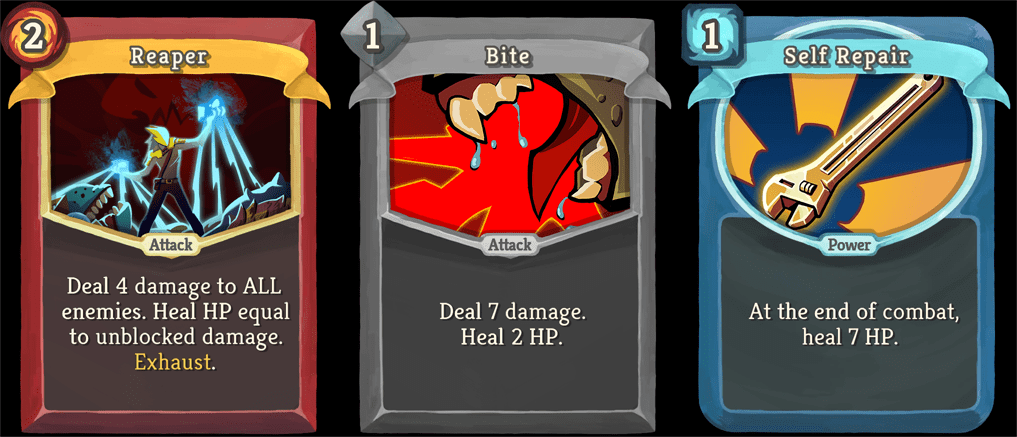
In the game “Slay the Spire,” players’ injuries don’t heal between encounters, which reduces their odds of survival in the future. However, players may occasionally get cards that are able to heal them. Cards with the “Exhaust” keyword can be used only once per encounter, but other ones can be used repeatedly. All player has to do is prolong the game till used cards are shuffled back into the deck, drawn, and used again, and the cycle continues. It’s a long, mundane loop that the player can afford to do once he encounters an enemy that has low damage output, but when he does, it’s “optimal” to repeat the mundane process over and over, until his health is full.
 Game Anatomy
Leave a comment