Multiplayer games often rely on matchmaking systems to automate the process of finding players to play with. If the rules of such systems aren’t transparent, players may suspect that the game is secretly manipulating the matchmaking behind their backs, creating an unfair environment. Even if the rules of a matchmaking system are publicly available, people may still suspect that some rules are lies or that some are still kept secret.
Why would game developers even rig the matchmaking? Mostly to keep the game enjoyable, for example, by finding opponents who have a similar skill level to you.
Some matchmaking rigging techniques are overall more acceptable than others, while some may be frowned upon. Opinions may vary depending on players’ goals or morality.
Game developers aren’t the only people who try to rig the matches – sometimes players try to exploit the system to rig the games themselves. This is the reason why details about such systems are often kept secret.
This article will explain where the desire for rigging games comes from. It will mention the ways games can be rigged and how rigging can affect the game itself.
Matchmaking factors
Regions
The further the players are from the server, the longer the communication delay is. If players are located on opposite sides of the globe, the latency may become very irritating, as such a player wouldn’t be able to quickly react to their opponent’s actions, and their own actions would be delayed. It’s a huge issue in action games.
By splitting the player base into several servers, games can group nearby players together to ensure a more stable connection and reduce players’ frustration. Players usually are free to choose the server themselves (at least during the account/character creation).
Since each server has a completely different player base, it also offers different challenges. For example, Korean players are known for being overall more competitive and skilled than regular players, making it more difficult to claim prizes for achieved rank.
Some players may try to exploit such nuances by transferring their account to another server, making it easier for them to claim some rewards or qualify for a tournament. Nowadays, some competitive games may reset players’ ranks (or other data) during the account transfer, to discourage players from such exploits. Additionally, players have access to a limited number of transfers, and they sometimes have to spend their currency.
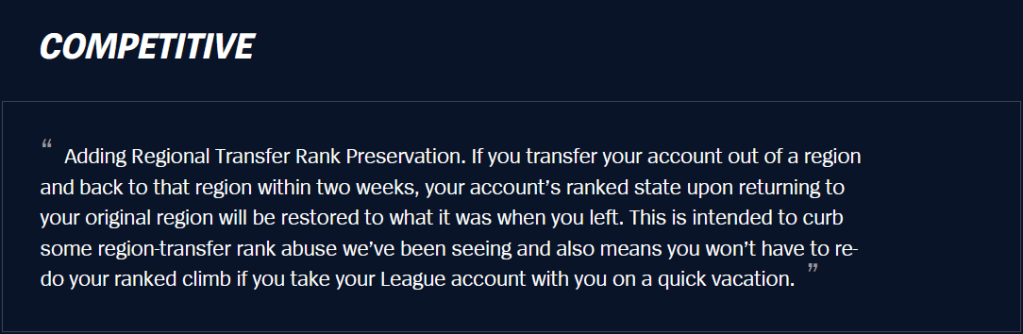
Measures against region transfer exploits were taken in patch 12.13 of the game “League of Legends”. Seeing such a change over 12 years after the game’s release shows how low priority this problem was, but nonetheless, it was a problem.
Account progression
Some games try to make the matches more fair by pairing players based on their account progression. The account progression can be split into a few categories.
Account/character level
In many games with a leveling system, players with a higher level usually have an unfair advantage over players with a lower level. Higher levels may mean bigger stats and more tools that give the player more versatility.
To ensure that even low-level players can have an opportunity to play PvP modes, some games try to create level brackets for players to ensure that the weakest accounts won’t be matched with the strongest ones. However, creating such a system may be problematic, especially in game modes that require dozens of people to participate at once, because it greatly reduces the number of potential players.
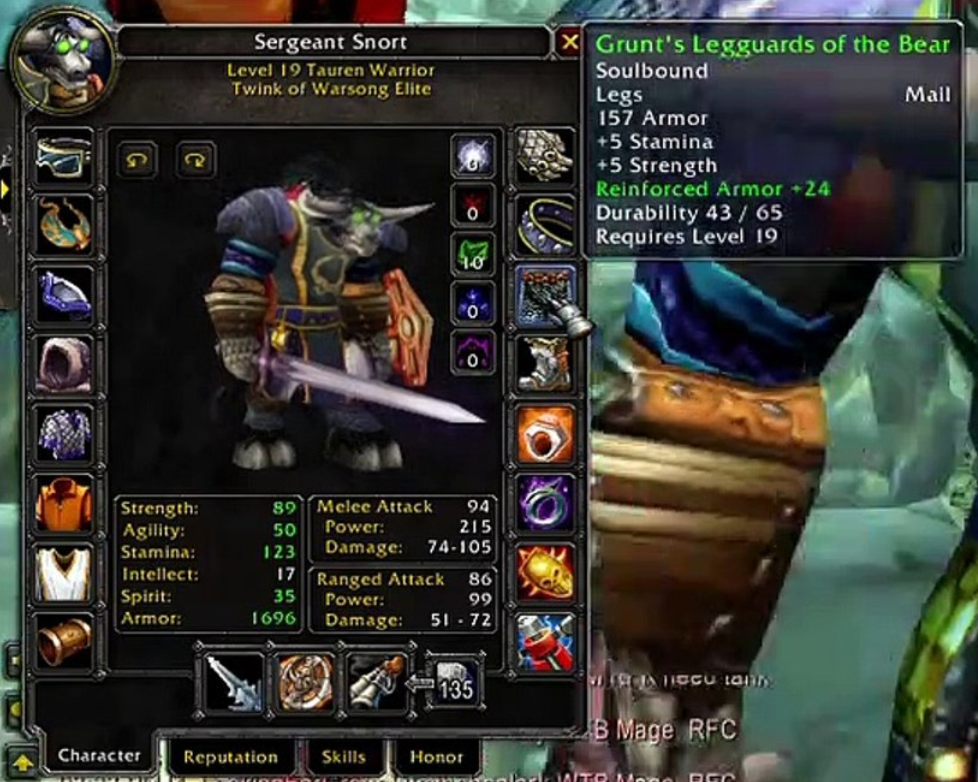
In “World of Warcraft,” PvP modes were divided into brackets with a 10-level range (the first bracket was for levels 10-19, 2nd was for levels 20-29, etc.). Some players figured out that they can purposely stop leveling up after reaching the top level of their bracket to gain an unfair advantage over other players. Such characters were usually made by players who already had another high-level character on this server. Using the gold from their main character, they could buy the best items available for this level, apply the strongest enchantments, and use the strongest potions and consumables. As a result, they became unstoppable, ruining the fun for other players.
Evening the ground
A lot of games try to reduce the problem related to the account/character levels by unifying levels for all players during PvP modes. Since progression is one of the most important aspects of most games, such precautions are usually made in games that are meant to offer mainly PvE experience. That way, players still have reasons to progress their accounts/characters, without having to worry about unfairness.
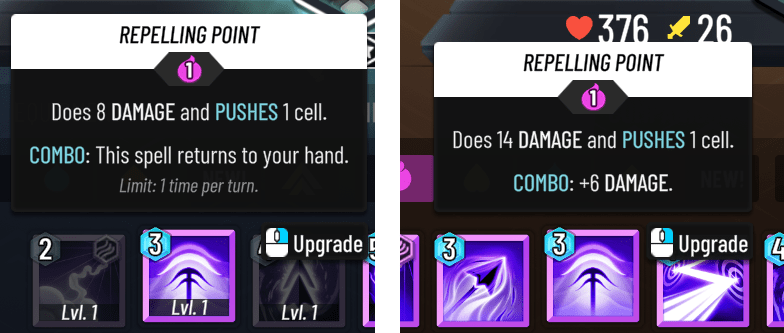
Some games not only unify levels of players during PvP, but also make separate balance changes for PvP and PvE modes. Some changes may only tweak numbers, while other changes may even change the way ability works. On the screenshots, you can see PvE (left) and PvP (right) versions of the same ability in the game “Waven.”
It’s worth noting that equal access to tolls may not be fun for everyone. Some players do love to have an unfair advantage over others, which is more common among players who can’t get the advantage in a fair way. Such players are often driven to the progression-based games, where they get stronger over time despite playing bad. This is also the reason why “P2W” games are generating so much money, despite unfairness.
Build rating and weighting
In some games, the build you’ve chosen may have a gigantic impact on your odds of success. It affects mostly the games that offer a huge freedom when it comes to customizing your character, deck, or anything you play with. Facing an opponent with a much better build may cause resignation, which is why some developers try to prevent it.
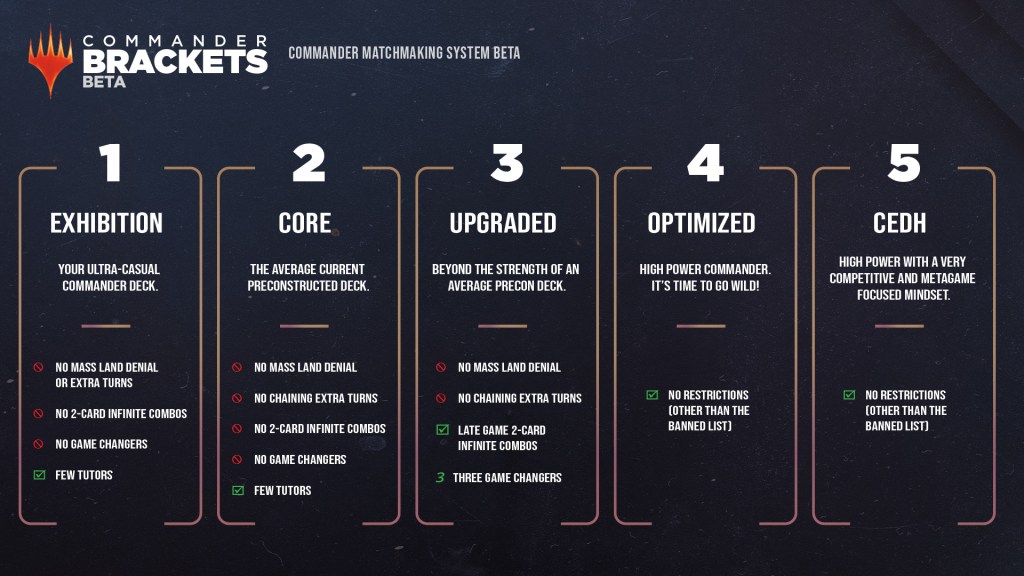
People who meet other people in real life to play the Commander format of “Magic: The Gathering” usually classify their decks using the bracket system. When they meet, they either try to find people who use decks of a similar level, or (if they have prepared multiple decks) they pick the deck that is the most appropriate. Meeting people in real life is much harder than it is in a digital world, which is why it’s necessary for people to take care of weaker players. Even though the bracket system isn’t mandatory, people use it, proving that the need for a matchmaking system is natural.
Build ratings are usually avoided in game modes with a competitive spirit, as certain other matchmaking factors take priority. However, in casual formats, developers aim to create a good experience for newcomers and bad players. A build rating may filter out exploits that would allow players with stronger builds to stumble onto newbies.
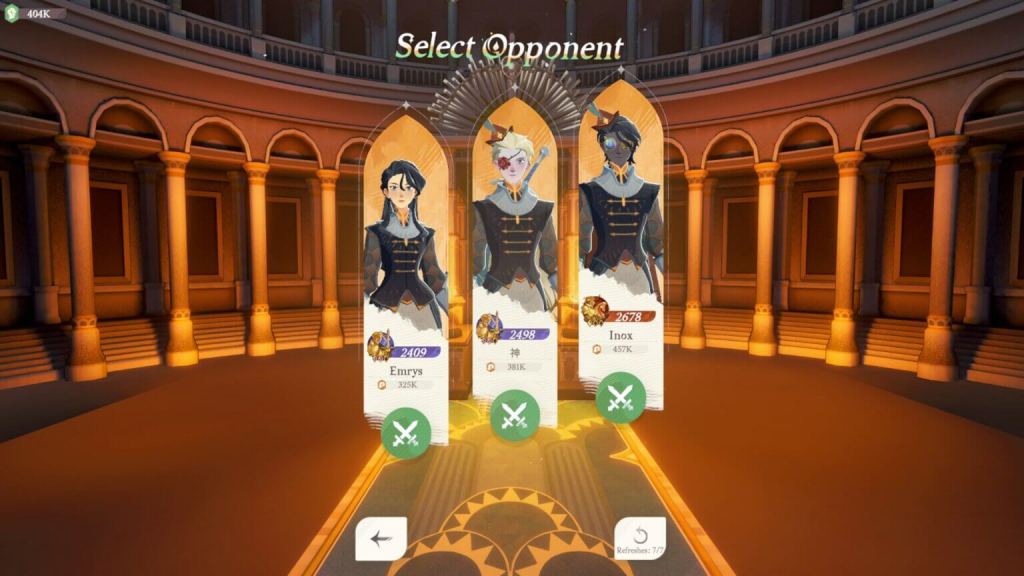
Games from the auto-battler genre, such as “AFK Journey,” often take a middle ground between competitive and casual gameplay. In PvP modes, players can select an opponent they want to attack. To make the choice easier, the armies of each player are rated based on the stats of included characters. People seeking less challenging fights may choose an opponent with a lower team rating, or re-roll the selection.
The systems behind ratings are usually relatively simple – the bigger the stats are, the higher the rating will be. The formula can be as simple as multiplying durability by offensive power. The higher the variety of stats is, the more difficult it is to properly estimate the rating for a character. This is why other matchmaking factors usually take priority.
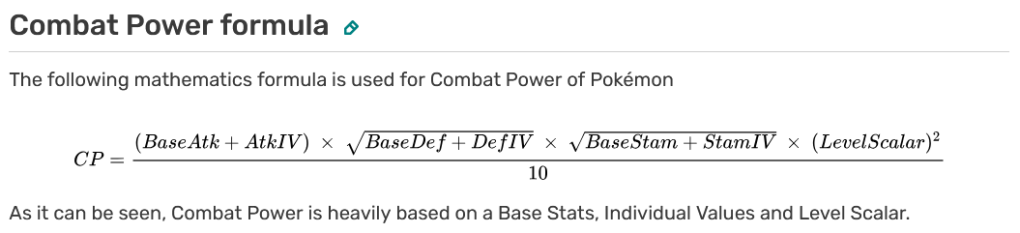
Here is an example of the formula for Combat Power in the game “Pokémon GO.” Even though all 3 basic stats are equally good in combat, surprisingly, the attack stat has a much higher impact on the formula. In practice, it means that in a PvP mode with a CP limit, bulkier Pokémon will be superior to an offensive one. The formula also doesn’t include the types of attacks the Pokémon knows, making Combat Power only a misleading estimation. People who want to play competitively have to deeply understand the game to maximize their chances of winning.
The more complicated the game is, the more difficult it becomes to make a proper estimation, especially if the game contains thousands of unique items. “Magic: The Gathering Arena” tried to implement a hidden system that rates the decks of each player, making them more likely to find an equal opponent. The details behind the system were kept a secret, but players discovered how it worked by reading the game logs.
A Youtube channel “Amazonian” made an in-depth video doing an in-depth analysis of the “Magic: The Gathering Arena” deck weighting system. An example of weighted cards can be seen below.
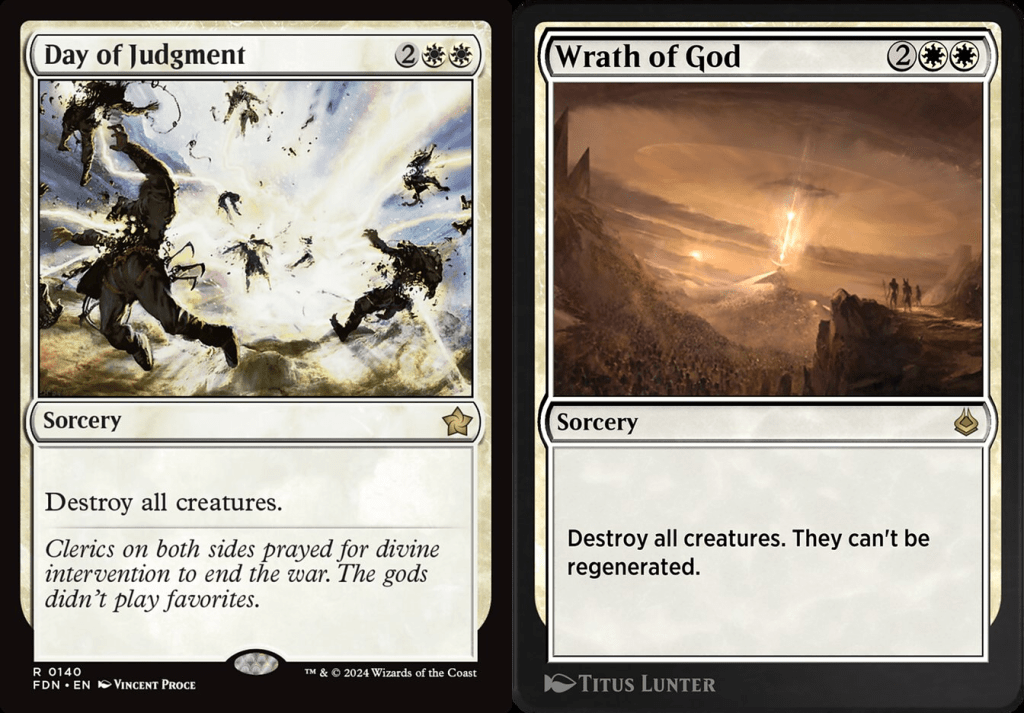
According to the gathered data, “Day of Judgement” had a weight of 18, while “Wrath of God” had a weight of 45. From the practical perspective, in this game, there are almost no creatures able to regenerate, meaning that in ~99,9% scenarios these cards will be equally good. Why is the second card’s weight almost 3 times bigger? My assumption is that since the “Wrath of God” is an old card, it belongs mostly to veteran players who are more experienced and have access to a wider collection of cards. Such players are more likely to create a good deck and use it well. If the system automatically weights the cards based on their performance, it will be more likely to rate commonly accessible cards lower.
Since the system mentioned above works only in some non-ranked formats, players can’t abuse it to get a higher rank in hopes of getting better rewards. However, someone who wants to rig matchmaking can analyze it to figure out how to drastically reduce the deck’s weight without losing much of its strength. As a result, the player will be matched against much weaker decks, despite having a relatively strong deck.
It’s also worth noting that this system doesn’t take card synergies into consideration, meaning that a well synergized deck will probably have a lower rating than a deck filled with random powerful cards. In other words, newbies who don’t synergize their decks will probably face decks that are overall stronger. Even though a deck weighting has flaws, it probably helps people more than it hurts them.
Performance/skill rating
Matching players based on their performance makes sense. If a player wins a vast majority of his games, then it would probably be fair to start matching him with better players. Games often use a system that resembles the Elo rating system known from Chess. The general idea is simple: each player has a number that represents their overall performance, and the game tries to match players with a similar rating. Winning against a better player boosts your rating more than winning against a weaker player. After playing a larger number of matches, the system can estimate their performance pretty well.
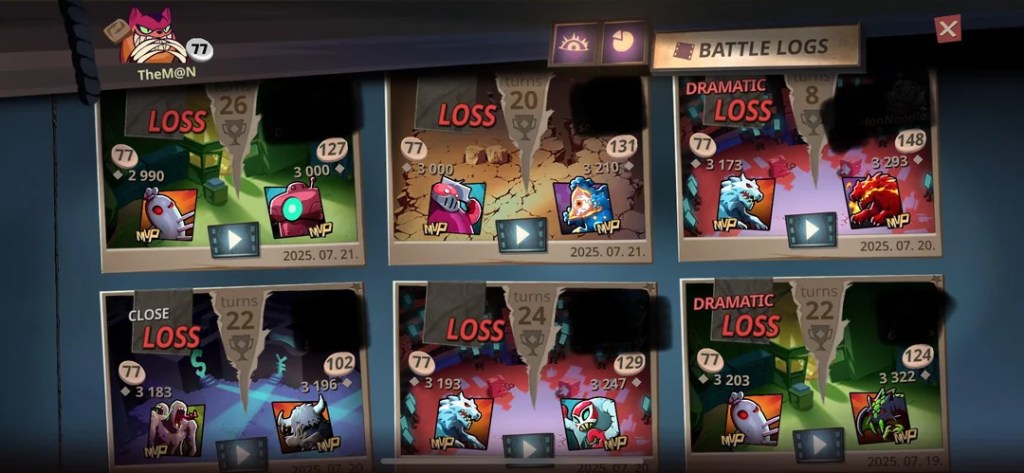
“Phobies” is a gacha game where players can see ratings and account levels of both players. Higher account level means overall stronger units and a greater pool of choices, meaning unfair advantage. Due to the strategic nature of the game, skill may outweigh the impact of account progression. Such a combination can cause a huge frustration among players who lose due to the unfair level advantage. These emotions may push the player into spending real money to increase the level and reduce the gap for further matches.
Matchmaking rating (MMR) is often hidden from players, and a rank is displayed instead. It simplifies the system and makes it more understandable to players, as they’re often already familiar with the terms bronze, silver, and gold. By hiding detailed information from players, developers may prevent them from hiding potential exploits, especially if the system is much more complicated than an Elo rating system.
The issue with the MMR is that players can relatively easily manipulate it. Some players purposely try to lose matches (either by conceding or losing the regular way) to reduce their rating. A low MMR means that your opponents will become much weaker than they should, which makes it much easier to win the match, and this can make the game less enjoyable for other players.
Smurfing
Players have come up with an exploit called “smurfing,” where they create a separate account just to start with a low MMR and be matched against much weaker players. Some players do it to boost their ego, some do it to check how different the skill level is, and some do it to learn new characters. In team-based games, the problem may be more problematic, as weak players ask veteran players to help them raise their MMR by teaming up with them on their smurf account. The process makes the game frustrating for their opponents (as they stand no chance against a skilled player), and the results are making the game frustrating for future teammates of the boosted player (as they end up with a weak teammate who isn’t supposed to be at their matchmaking level). Such exploits are widely hated among players in
Games try to take various precautions to protect other players from system abuse. For example, it became a common practice to create a mechanism to prevent rank demotion after reaching certain thresholds. It’s especially important for beginner-level ranks, as they could lose interest in playing the game after being crushed by a veteran player. It also gives veteran players an opportunity to test out new play styles without risking their rank.
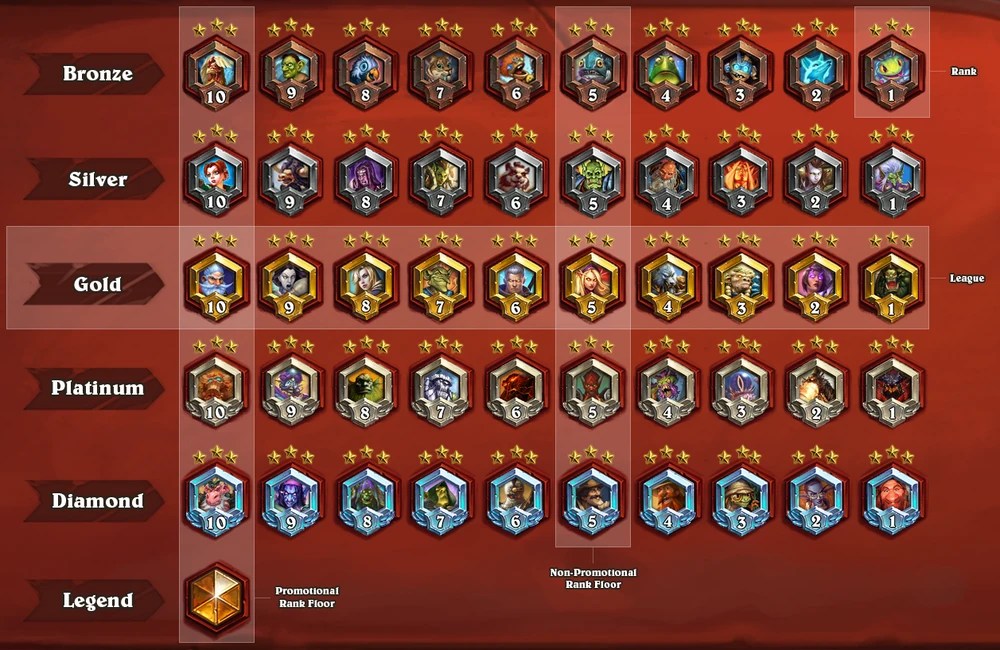
In the game “Hearthstone,” players get protection every 5 ranks they get. After reaching such a rank, players have a good opportunity to test out new strategies without losing their progress.
Rank systems often tempt players with rank-based rewards to encourage them to reach as high a rank as possible, hoping that players will end up in a place that really fits their skill. It discourages some players from intentional rank manipulation, as they may lose some rewards in the process. Unfortunately, if rewards are season-based, players may still try to stay at lower ranks at the start of the season, knowing they will be able to catch up later.
Some games have implemented a system that manages rank changes at regular time intervals. It makes it impossible for players to quickly drop their rank, as they usually will have to wait a few days for the rank to change by one step. The more ranks are available in the game, the longer it will take to drop to the bottom. This solution is popular mostly in mobile games.
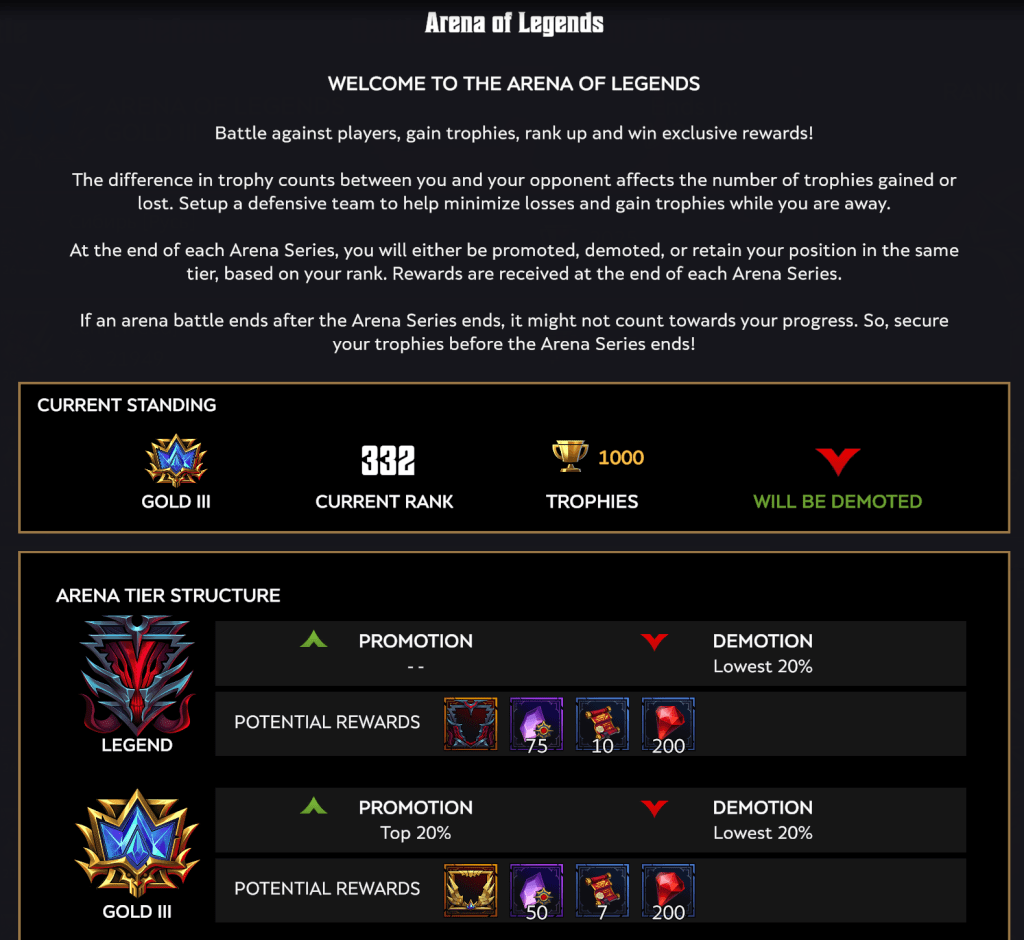
In the game “Grimguard,” player rank is updated once every 3 days. Higher ranks not only offer bigger rewards, but may also offer rewards unavailable in lower ranks.
Desired imbalance
It’s also worth mentioning that some players enjoy the variety of skills among opponents. Sometimes, playing against someone worse feels great because it makes the player feel like their effort paid off and they became a better player. Playing against much more skilled players can also be great, as you can truly test your skills and learn something new. However, such an imbalance benefits mostly average players. Bottom players may feel resignation after losing all the matches, while the top players may feel bored after playing only games that are not challenging for them.
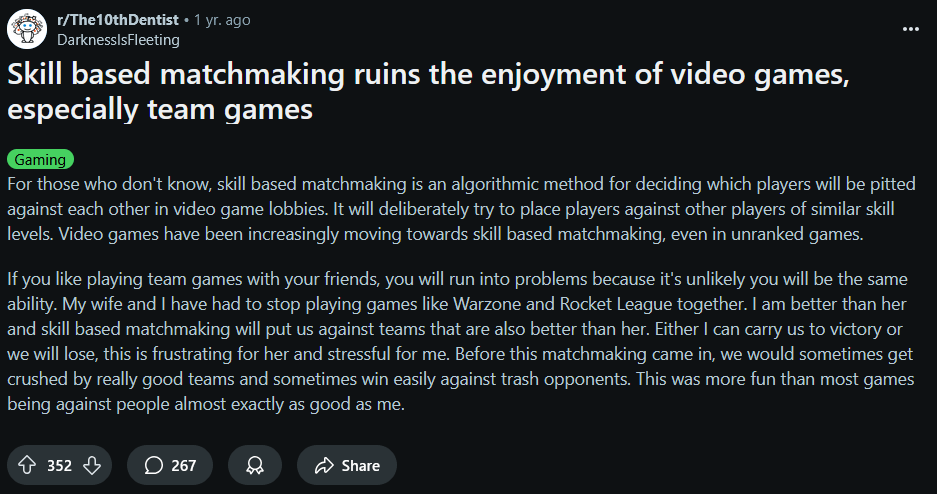
A Reddit user pointed out that skill-based matchmaking may ruin the enjoyment of weak players who have teamed up with more skilled players. His post got hundreds of upvotes, showing the world that many people agree with him.
Misinterpretation of the MMR system
People used to winning most games become irritated when they can no longer achieve that. Since the MMR is meant to keep the player’s win rate close to 50%, it will progressively start giving them harder opponents until they finally get equally good opponents. Such players often perceive it as “an attempt to make them lose,” rather than an attempt to make the matches more fair. The frustration becomes even stronger if their losses are caused by randomness. On forums of popular competitive games, many players will claim that the system is rigging the randomness to make them lose, just because they had a win streak earlier. Such players will often reject the possibility that it could be just a coincidence.
Queue duration
The more restrictive the matchmaking rules are, the more time it takes to find suitable opponents. People came to the conclusion that it’s better to play any match rather than not play at all, even if the match won’t be as fair as players would want it to be. This is why matchmaking systems often try to loosen up their restrictions over time, increasing the odds of finding an opponent.
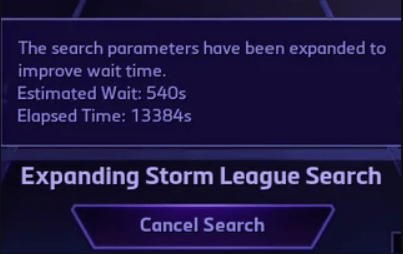
“Heroes of the Storm” is an example of a game where search parameters are expanded over time if a player fails to find a match. Even with such a feature, queue times may be annoyingly long, especially for the top players.
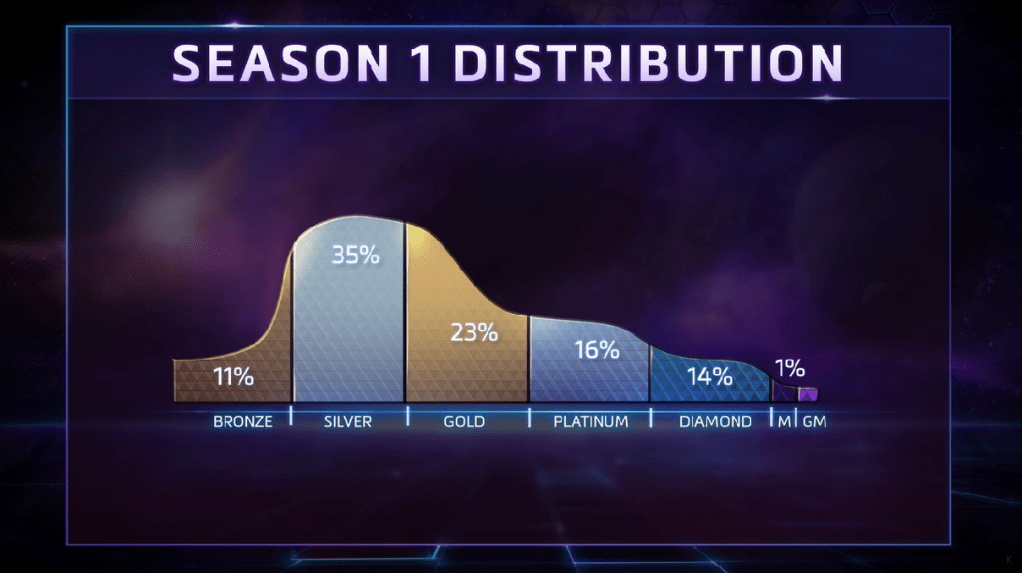
Here is an example of player distribution over the different ranks in “Heroes of the Storm.” Smaller pool of players explains why the top players and the bottom players will have more struggles finding a match for themselves.
It makes sense that the searching should be extended if a player can’t find a suitable opponent. Since most of the players are average, they’re unlikely to have their search range extended. In some unpopular games with a badly coded matchmaking system, it may cause an issue where top players are being matched with bottom players, just because average players will always find someone else in the meantime. The skill gap between those players will be ridiculously big, ruining the experience for both of them.
Players who’re exceptionally good may have their rating so high that they may spend more time searching for fair opponents than actually playing the game. The waiting queues may be so frustrating that some pro players may intentionally concede their games just to drop down their ranks and be able to play again, even if it means crushing less experienced players.
The number of players online varies depending on the time. Usually, games are less popular when people sleep or go to school/work. Finding an appropriate opponent may be more difficult during certain hours.
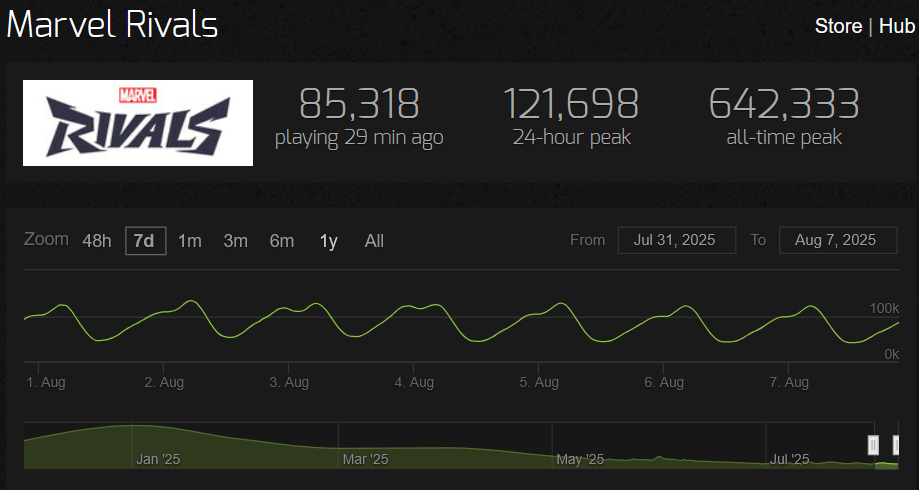
In the game “Marvel Rivals,” the top popularity each day is approximately three times that of the lowest one. Luckily, even at the lowest point, the popularity is still huge enough, but the issue may severely affect less popular games.
Some games deal with matchmaking issues by matching players against bots. This solution works pretty well for newcomers, as it’s relatively easy to create a weak bot, and newcomers will struggle to figure out that they’re not playing against a living player. However, such a solution won’t work well for the top players, as they will probably consider bots easy and repetitive.
Recent activity
It makes sense to assume that a player who has had a break from the game usually won’t perform as well as an equally skilled player who has warmed up. A matchmaking system can take such scenarios into account to slightly improve the overall experience of the player. Giving a returning player slightly weaker opponents may create a good environment for warming up. Developers behind “League of Legends” noticed that returning players usually won only 44.5% of matches (which is very low, considering that there are always 4 other players on their team). After adjusting the matchmaking system, they increased the odds of winning to 48%.
There are multiple other factors that could also be taken into consideration. For example, people who lose multiple matches in a row may lose the motivation to play the game. Since game developers don’t want to lose their player base, some of them may implement systems that will give such players weaker opponents, allowing them to succeed and stay motivated.
“Nerfpool” has made a video where he analyzes the matchmaking system of the game “Marvel Rivals,” including the benefits of such a system and controversies that it can cause.
The main issue with such systems is that transparency makes it easier to abuse them, but a lack of transparency breaks trust between players and game developers.
Sometimes, the impact of the recent activity is even visible to the players. Games often give players extra rating points for achieving a winning streak; as such, people probably greatly exceed their current rating level. Such a feature speeds up the process of placing each player in the right place, making the gameplay fairer for everyone. This system makes it easier to understand why they are ranking up fast and why they start getting much harder opponents.
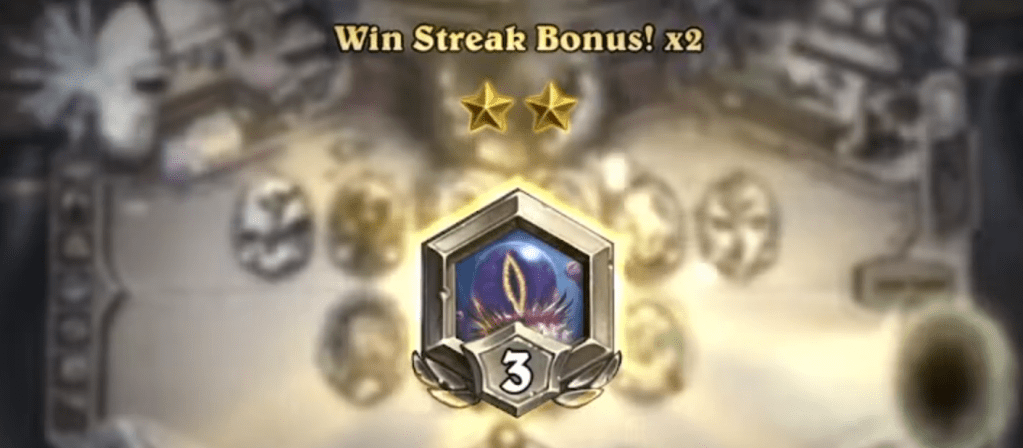
In the game “Hearthstone,” you get a win streak bonus after winning a match if you’ve won 3 or more matches in a row. It doubles the speed of climbing the ladder, as long as you keep winning. Since the bonus is meant to keep good players away from the bad players, the bonus isn’t available at ranks Diamond 5 or higher, to ensure the top-level competition does not depend on lucky streaks.
Unless the game involves a lot of randomness (such as randomly generated maps or drawing cards), the match against the same opponent usually will end up with the same results, especially if the winner ended up with a huge advantage. Playing another match against a player who has crushed you just a moment ago may create a feeling of hopelessness and resignation. The match also won’t be engaging for the better player, as the weaker player is unlikely to come up with a new play style, making the game feel repetitive. Matchmaking systems often ensure that players won’t get matched against opponents they’ve faced recently, especially during tournaments.
Preventing players from being matched against the same opponents also makes it more difficult to abuse the matchmaking system. In unpopular games, friends may try to join the matchmaking queue at the same time during unpopular hours, to ensure they’ll be matched against each other. Once this happens, one of them may instantly concede the game to grant quick rewards to another friend, and then repeat the process. The exploit may look different depending on the game. For example, some games won’t grant any rewards if the match wasn’t long enough, or they scale the rewards with the number of interactions between players. Such exploits not only create frustration among players who feel punished for playing fair, but also may corrupt analytical data.
Game modes
Different game modes often require different sets of skills. Usually, these sets overlap, and experience gained in one game mode may impact performance in other game modes. However, some game modes may teach wrong habits. For example, in MOBA genre, there is a popular game mode called All Random All Mid, which may teach players adaptation (due to the randomly selected characters), but will neglect their map awareness skill (as there is only one lane) or objective prioritization (as there are almost no objectives to choose from). With such differences, having separate ratings for modes is necessary to avoid discouraging players from playing other modes.

“Magic: The Gathering Arena” has a whole separate ranking for the constructed and limited modes. The first one requires a decent card collection, knowledge of all cards, and creativity. The second one focuses on a small set of cards and adaptability to randomly drafted cards. Both modes also have different pacing, and the effectiveness of the cards may notably differ.
There are also game modes that require the exact same set of skills. The simplest example would be splitting one game mode into a casual mode and a ranked mode. Players may choose casual modes for reasons such as:
– desire to practice (which implies using a play style they haven’t mastered yet)
– experiment (which may result in using play styles that may turn out not to be good enough for competitive play)
– have fun with friends
– being temporarily less performant (e.g., due to being tired after a long day)
But the reasons behind their choice aren’t as important as the fact that their performance may differ. Also, people wouldn’t want their casual play to impact their achievements in the other game mode – after all, it’s the main reason why these game modes are separated.
Tournaments
It’s worth mentioning that some game modes don’t use MMR by design. It’s the case mostly for the tournament modes, where the point of the game mode is to find the best player in the pod in a short amount of time, judging only their current skill. Because of that, it wouldn’t be fair to include the MMR system that has been tracking players for months. Tournament modes usually base the placements on the number of wins during the tournament.
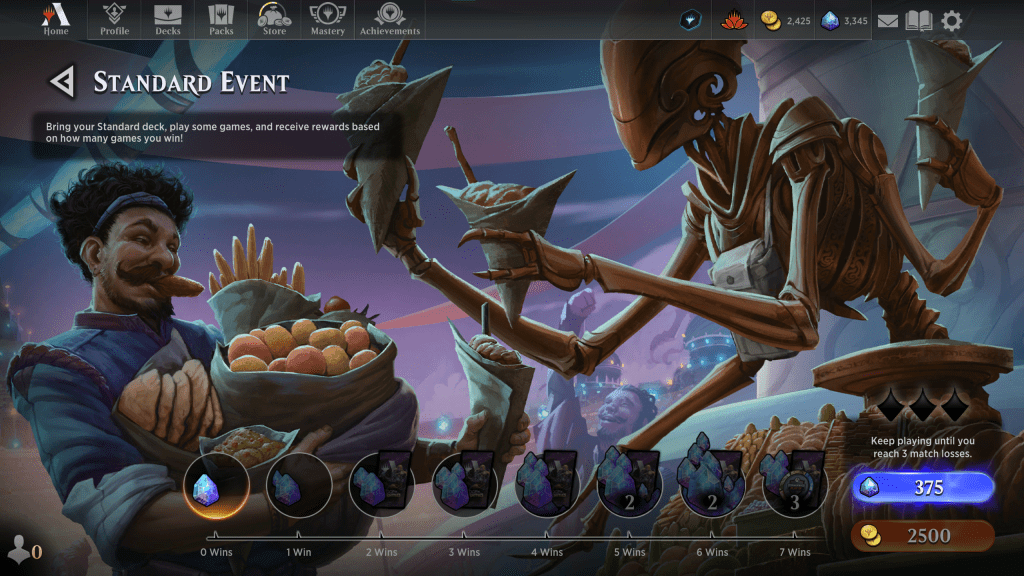
In “Magic: The Gathering Arena,” players have the option of participating in events with a paid entry. Due to the cost barrier, such events have a smaller player base, as players rarely can afford them. Since these events often don’t base their matchmaking on the MMR/rank, the skill range of players you can find there is huge. Only the most skilled players are supposed to win top rewards.
Free-for-all modes
There are also game modes that don’t require strict matchmaking. It applies mostly to free-for-all modes, where players understand that they’re unlikely to win, and they focus on gaining a high place instead. Games from the battle royal genre often start with 100 players in a single match, which would make it difficult to find players of equal skill (especially if the game is not popular). The chaotic nature of this genre also makes it unlikely to take last place multiple times in a row. Games from the auto-chess genre are also based on FFA mode, but are much less chaotic and include a much smaller number of players (8), which makes MMR more meaningful and desirable.
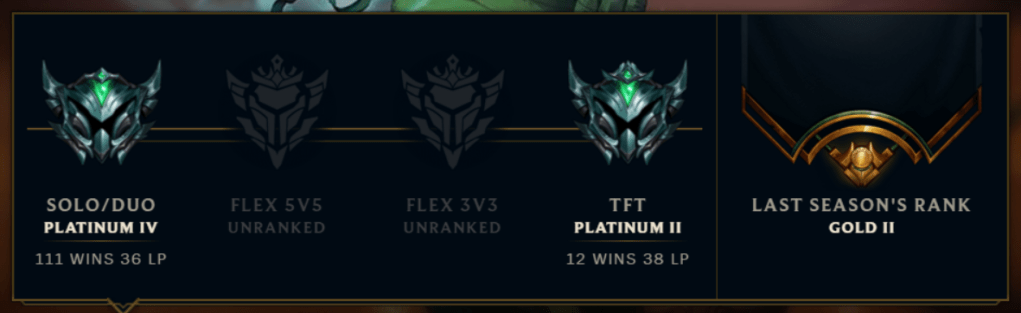
“Teamfight Tactics” is a game mode from the auto-chess genre. Since good players are able to consistently achieve better results, it makes sense to match players based on their skills. After all, weak players also want to occasionally win the match.
Archetype factor
Competitive games tend to offer a huge variety of archetypes, where each archetype requires a different play style. For example, a player who plays as an assassin is supposed to reach and eliminate the most threatening opponent, while support players are meant to help other teammates fulfill their roles. Different roles struggle with different threats and require different sets of experiences.
Character selection
In team-based games, matches are often preceded by a character selection, where players declare their choices. For the best result, players should not only base their decisions on their team composition, but also on the enemy team and the selected map. In games with an established meta, players often feel obligated to follow it. For example, in MOBA games like “DotA 2” or “League of Legends,” there are 4 main sources of income despite teams consisting of 5 players each, meaning that one player in each team will be left out without decent income. Players have figured out that it’s usually best if that position is claimed by a support character because they need gold the least. If nobody in the team took a support role, players felt forced to pick that role if they want to win, even if they don’t play it well or simply don’t like that role.
This dynamic slowly increases the toxicity of players in such games. It led to many unpleasant scenarios, such as:
– losing a match because a player picked a needed role they aren’t familiar with
– losing a match because a player wanted to pick a role that is unlikely to win the current team composition
– players arguing about who gets to claim a particular role
– a player leaving the match during the character selection (hoping that they will get a more suited team next time), forcing 9 other players back into the matchmaking queue, and going through the character selection again
– a player threatening other players that they will try to purposely lose the game unless they comply with that player’s demands (such as picking the needed role)
Developers of “League of Legends” have taken a lot of measures to reduce the frequency of unpleasant scenarios caused by the existence of roles:
– increased the passive income of support characters, to make them more impactful and desired
– increased the variety of characters for each established role (so everyone can pick something that matches their style, regardless of their assigned role)
– added penalties for leaving the match during the character selection, depending on the number of recent leaves (6/30/720 minutes of queue penalty, and -5/-15/-15 league points if it happened in ranked mode)
– added role declaration of up to 2 preferred roles (once character selection starts, roles are assigned to the players by the system, but they still have an option to not comply)
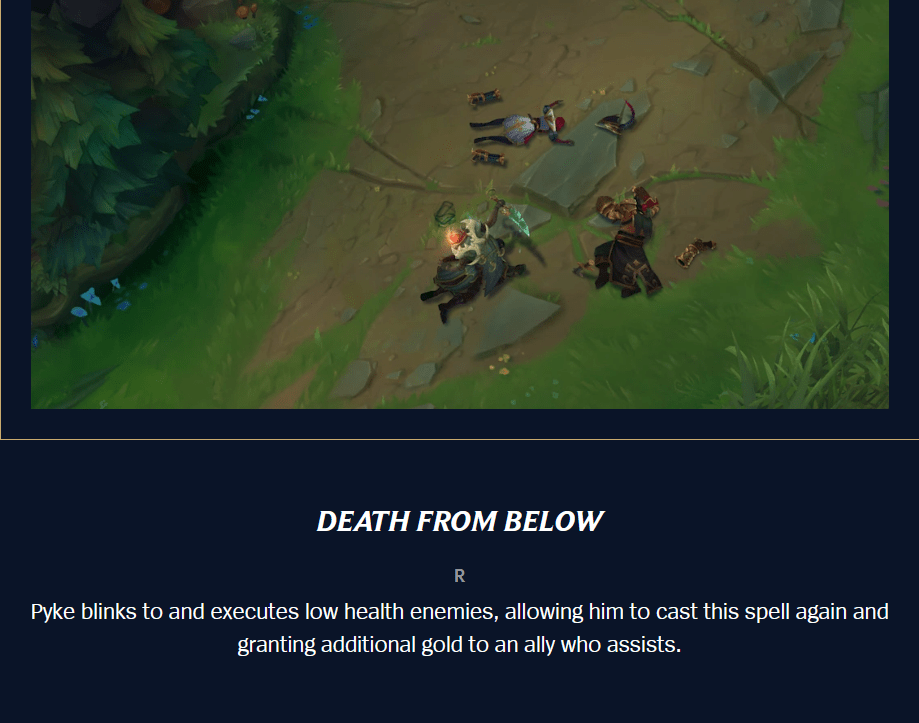
In “League of Legends,” only the player who deals a finishing blow to the enemy receives full reward for the kill, while assisting players only get a fraction of it. Since the gold doesn’t give many benefits to the support roles, players who played them were obligated to avoid taking the kills. To appeal to players who like to play assassins, developers added a champion that can grant extra gold to his allies after successfully killing an enemy champion. Thanks to that, no one has grudges if that “support” assassin steals their prize.
Preferred roles
As I mentioned earlier, some games offer players a role declaration. It not only prevents unnecessary arguments but also lets the game match players based on their experience with selected roles. For example, if skilled players want to try roles they have no experience with, it would make sense to give them opponents of a lower skill level than they would normally get. Such a system was implemented in the “Overwatch” game. To prevent potential exploits related to the role switching, players are only allowed to select characters that match the declared role.
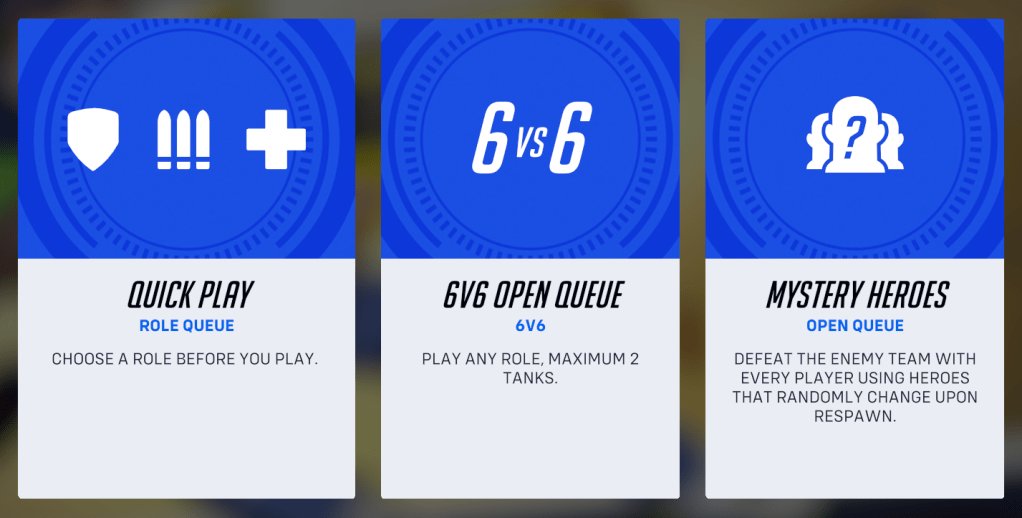
In the game “Overwatch 2,” you have the option of joining a quick play queue. In this queue, you can select up to 2 roles out of 3 available, ensuring that you will play the way you want, without any unnecessary drama.
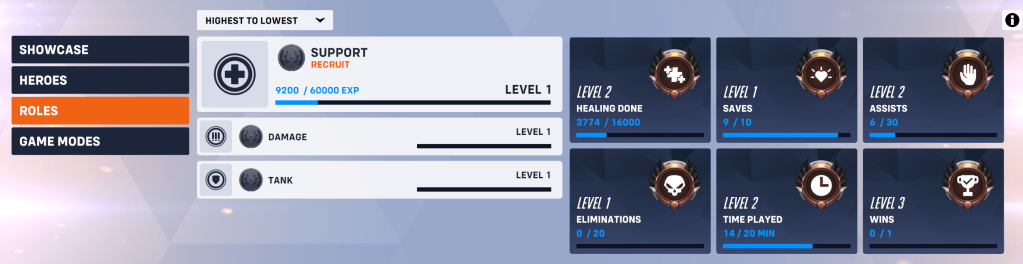
The game tracks players’ proficiency with each role, making it easier to match suitable opponents.
Team composition
Sometimes games have to add arbitrary rules to protect players from themselves. In the past, people have figured out that playing “Overwatch” as a team of 3 tanks and 3 supports gives the highest odds of winning. Unfortunately, such games were slower, making them much less exciting. It also discouraged players from playing damage-based roles, which took the fun away from players who previously enjoyed playing them. To make the games more engaging, restrictions on the roles have been added. Currently, in “Overwatch 2” you can’t have more than 2 tanks in the team.
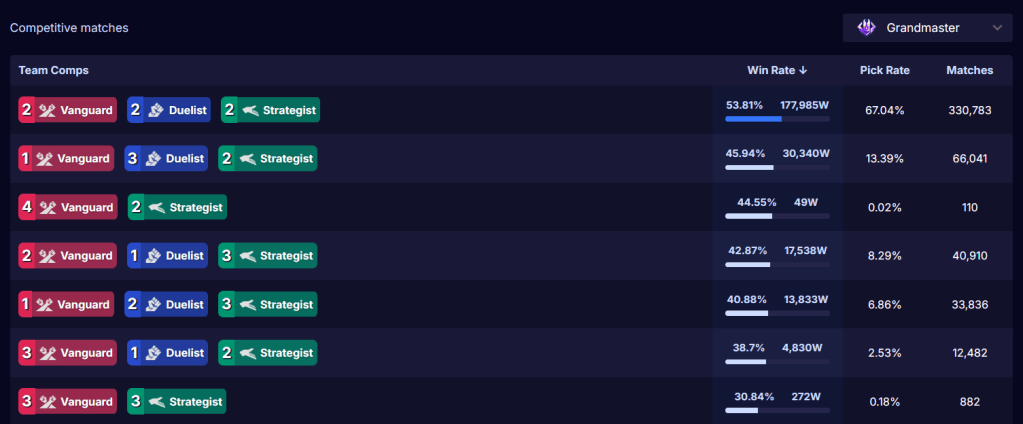
The team composition is more important than a new player would expect. “Marvel Rivals” is a hero shooter that divides its characters into 3 categories. Picking a non-optimal composition severely reduces the odds of winning. Luckily, the optimal way of play requires all the roles to be present, ensuring the variety and making the game interesting. With a great character balance, artificial restrictions are not necessary.
Match-ups
Even though your team composition is important, so are match-ups with particular enemies. Each available option has its own strengths and weaknesses, and it’s important to exploit the weaknesses of the opponent without letting their strengths shine. Doing it consistently well requires a lot of experience with many play styles. However, if you’re lucky, you may encounter an opponent whose play style is weak against your play style. Technically, the matchmaking system could be tweaked to take it into account, but it may be difficult if the variety of play styles is too high. MOBA games would make it even harder, as the players claim their roles after matchmaking fills the lobby.
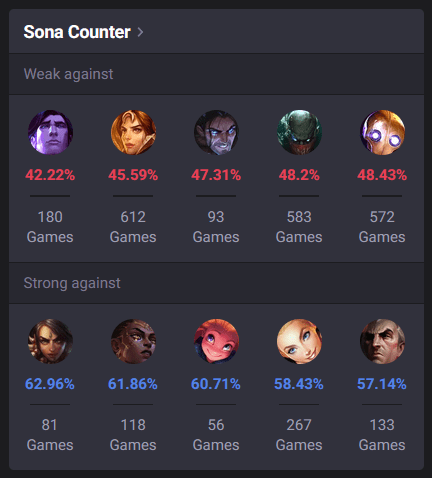
In “League of Legends,” you can easily increase your odds of winning by 10% or more by responding to the opponent’s pick with the right champion.
Each game may have a different vulnerability to the archetype-related issues. For example, MOBA games often let you adapt to the opponents with the itemization system (e.g., you can buy items that grant you magic resistance to make enemy mages less threatening), making it possible to reduce unexpected gaps. For comparison, collectible card games usually lock your deck in the moment you join the matchmaking queue, without giving you the chance of adapting to the opponent.
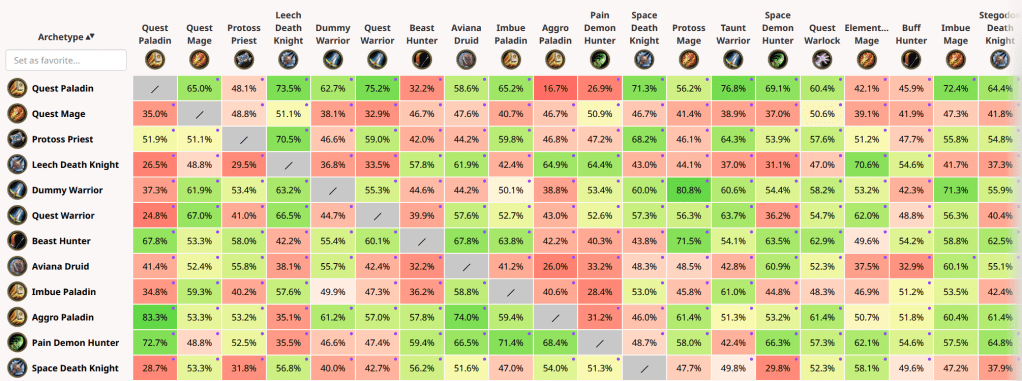
In the game “Hearthstone,” the deck archetypes’ match-ups have a gigantic impact on your odds of winning. For example, even though “Quest Paladin” currently has overall great performance, it will have only ~16,7% chance to win against the “Aggro Paladin” archetype, making it almost guaranteed to lose the game.
The bigger the impact of the archetype is, the more unpleasant emotions matchmaking may make. It not only makes the match-up problems more noticeable, but also makes the players less forgiving towards them. It may trigger some biases, such as clustering illusion (where people have a tendency to notice patterns in random scenarios and consider them non-random) or frequency illusion (starting to notice something more frequently after becoming aware of it). Driven by such biases, many players tend to create conspiracy theories, believing that the system is rigged against them and is purposely giving them unbeatable opponents to make them lose. It can lead to a loud vocalization of this problem, triggering confirmation bias, and spreading the problem even further.
Truth to be told, since one-sided match-ups usually aren’t fun (at least for the losing side), it would make sense to get rid of such scenarios. For example, if we assume that the match is fun if the odds of winning are in the range 30%-70%, we can create a system that tries to predict the outcome of each match-up and prevents match-ups that are out of this range. This, however, creates another problem – it gives players the opportunity to rig the gameplay on their terms. The game would no longer be about being the best, but rather about finding a way to engineer a build that abuses the system the most. Continuing the previous example, a player with a deck able to win 71% games against one match-up and 31% games against all other match-ups may purposely weaken it by 2% to eliminate losing match-ups and make good match-ups possible, effectively increasing the win rate from 31% to 69%.
Build weighting
Earlier in this article, I mentioned that some games use a weighting system to match players according to their builds. Since each build archetype may have a different weight range, small changes to the build can greatly affect the types of opponents you can encounter. Not only does it decrease the variety, but it also may put you in unfair scenarios, where you’re constantly facing builds that are able to counter you.
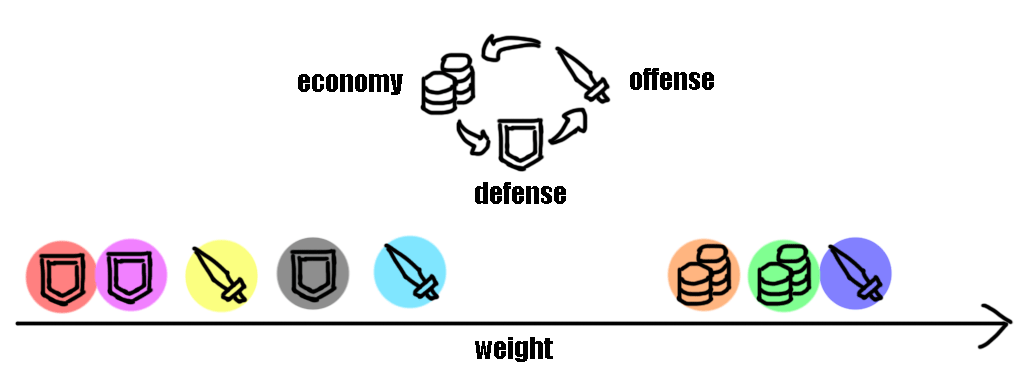
An illustrated example of how build weighting may ruin the game balance. Even though some strategies are more powerful than others, they still have weaknesses and may be ineffective against more generally worse strategies. Let’s assume that a player decides to play the yellow strategy. If the matchmaking tries to match him with decks of similar weight, that player will most likely face defensive strategies that counter him. They may switch to a better cyan strategy, but the results will be similar. Once that player decides to try economic strategies, they will never meet the defensive ones, resulting in losses again.
Some players will try to adapt to their opponents, either by modifying their build or trying a completely different build. Unfortunately, in weight-based matchmaking, such modification may completely change the type of encountered opponents. Without being able to analyze the weights of each build, it’s hard to predict if your match-ups will change for the better or worse. There is a chance that after evaluating and improving your build, your results will become even worse than before.
People affected by this problem will often feel like the Matchmaking is forcing them to lose. They may perceive it as something unfair and will want the system to change.
Controversies
Upgrades without downsides rarely exist, which is why opinions about various matchmaking systems can be divided. Usually, developers just want the game to be as fun and as least exploitable as possible. However, some developers may have worse intentions.
Activision patented a matchmaking system (US9789406B2) that is meant to push players towards micro-transactions. Game companies often try to improve their revenue streams, but it usually comes with a cost. This time, the goal was to make people desire something other people have bought. It probably wouldn’t be that controversial if it were about buying cosmetics.
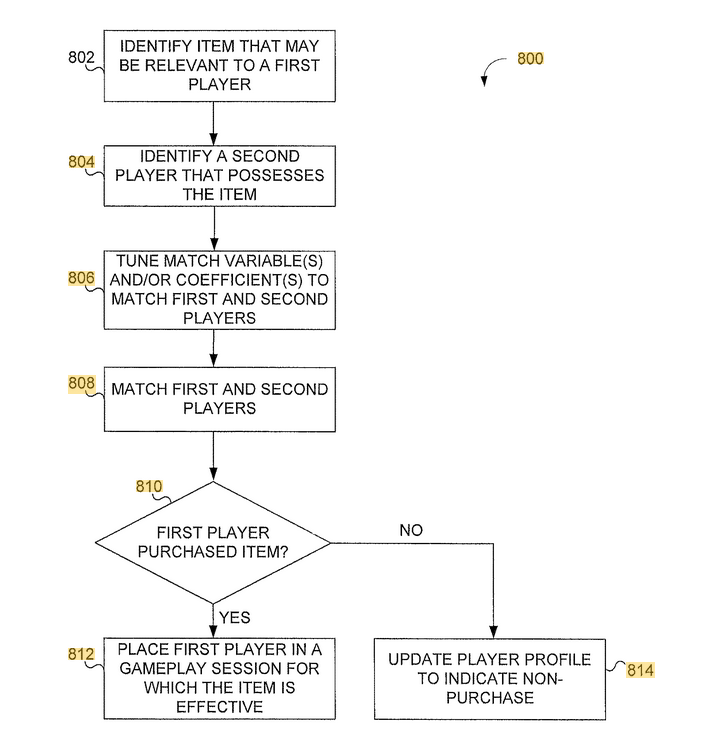
This diagram was used to illustrate the logic behind the patented system. Operation 812 mentions the item’s effectiveness, which implies microtransactions that affect the probability of winning the match.
Players who bought the microtransaction were meant to gain more favorable matches, meaning that a regular player would be at a disadvantage in a match-up against a paying user. It was designed to upset regular players, encouraging them to change their fate by paying money.
Just because they’ve patented such a system, it doesn’t mean that they’re using it. Unfortunately, the details of the matchmaking systems implemented in games are almost always kept secret, meaning it’s like Schrödinger’s cat – we won’t know the truth as long as we can’t check what’s inside. People rarely do something they haven’t planned earlier, meaning that they likely had intentions to implement such a system.
Even if that system wasn’t implemented, there is always a chance that another similar system was added to the game.
What makes things worse, people are afraid that even if that company hasn’t implemented it, there is a chance other companies may be inspired by it, and try to design their own systems meant to upset people.
People are also concerned that such manipulations may affect more than matchmaking. For example, in games that include randomness, developers theoretically could rig the random effects to favor particular players. While some people only suspect companies of rigging, some may deeply believe that it’s actually happening.
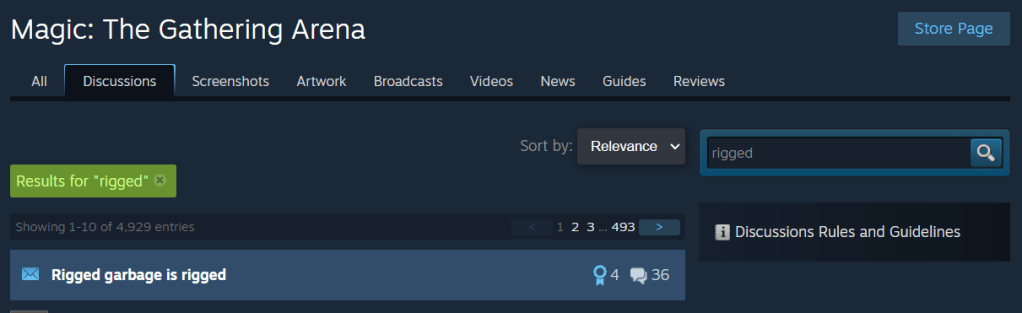
The word “rigged” was used almost 5000 times on the Steam forum of the game “Magic: The Gathering Arena.” It shows how important this topic is to people.
People who claim that companies rig their games are often ridiculed, as they usually fail to provide decent proof for their claims. Other players often think that accusers simply try to justify their losses by blaming some external factors. Considering that people are vulnerable to dozens of biases, it’s quite likely that the rigging they talk about has been born inside their heads, and doesn’t exist in the game. But no matter if the rigging in a game exists or not, accusers are likely to abandon the product they don’t trust, which could result in lost profits. The problem is even bigger when these players are loud, as they’re ruining the company’s reputation.
Summary
Matchmaking is quite controversial, as it can be rigged for many purposes. Different players have different ideas of what is fun, which makes it difficult to please everyone. Given the opportunity, some players will try to rig the game themselves, possibly ruining the fun for others. Developers often try to make countermeasures by making it more difficult or by implementing a system that tries to address their needs or distract them from temptations.
A badly designed matchmaking system may replace the old problems with new ones. Not every game needs rigging, and different games may require a different approach to this subject. Sometimes, the best option is to let players choose how they want to play the game.
Transparency builds trust between players and companies, but increases the odds that players will try to abuse the system.
I believe that the best system is the one that brings players the most engagement. Intention is what truly matters.
 Game Anatomy
Leave a comment